Project
Mumble Melody
Musically modulated auditory feedback to increase fluency for people who stutter.
Overall aim: To increase stuttering fluency utilizing altered auditory feedback (AAF) in the form of a mobile application.
Members: Rébecca Kleinberger, Alisha Kodibagkar, Megha Vemuri, Akito van Troyer, Satrajit Ghosh.
Specific goals
- Create a simple and effective medical tool
- Improve quality of life for People Who Stutter (PWS)
- Learn more about speech functions
Project description
Stuttering is a condition characterized by involuntary, periodic disturbances in speech fluency, usually via sound repetitions, blockages, or prolongations. This condition improves when an individual’s speech is played back to them in an altered manner — most famously when delayed by fractions of a second, but also when the frequency is shifted, when masked with white noise, and when reading in choral speech. This phenomenon of altered feedback-induced fluency is theorized to result from a reduced ability to detect small errors in articulation that occur in stuttering, which reduces its inhibition on speech initiation and output via the feedback mechanism.
In people who stutter, there is both structural and functional evidence of atypical hemispheric lateralization of speech and language. People who stutter, when speaking fluently, tend to activate the right hemisphere during speech tasks. The white matter integrity is disrupted on the left. This rightward shift of speech function may be compensatory (as opposed to causal). Trials comparing fluent versus nonfluent trials in people who stutter reveal the former to be associated with activity in the right hemisphere and the latter with the left hemisphere.
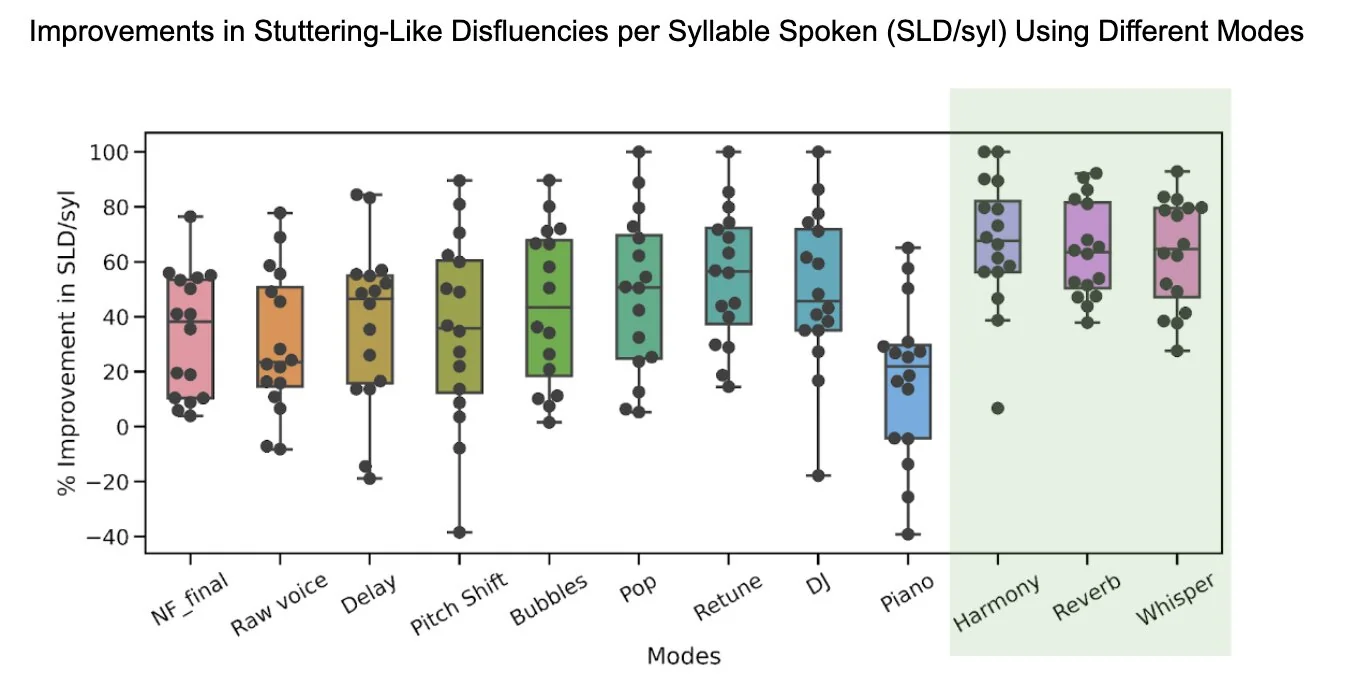
Mumble Melody is interested in working with people who stutter (PWS) to improve their fluency utilizing this information. We have created a mobile application that transforms the user’s voice through their microphone input and plays it back to their headphones in real time. These transformations come in the form of AAF with options to play the voice unaltered, reverberated, whispered, or with a harmonious effect. This tool is meant to be more efficient, affordable, and simple than traditional AAF devices or other stuttering therapies.
Publications
Kleinberger Rébecca, George Stefanakis, Satrajit Ghosh, Tod Machover, Mike Erkinnen:Fluency Effects of Novel Acoustic Vocal Transformation in People Who Stutter: An Exploratory Behavioral Study, SNL 2019: Society for the Neurobiology of Language, Helsinki, Finland, August 2019.